
4 Step Resilience Exercise: Designing Your “Worst Case” Scenario
The Anchor: Why We Need a Worst Case Scenario Plan
Last week, we armed ourselves with the 5-4-3-2-1 Rule to break inertia and simply start.
But if you’re anything like me, a few steps into a meaningful goal, and the whisper changes. It gets louder. Heavier. What if this doesn’t work? What if I fail?
This is where most dreams quietly die. We may have the desire and discipline, but we don’t have a plan for what happens if things don’t go perfectly. In the absence of a plan, fear takes over, and inaction feels safer than moving forward.
Here’s the truth I uncovered as I’ve explored intentional living more seriously:
The deepest fear usually isn’t financial ruin or physical hardship.
It’s how we imagine we’ll look in other people’s eyes.
Judged.
Dismissed.
Seen as naïve.
Seen as “not enough.”
That’s why the biggest hurdle in your 4-Step Framework to Overcome Limiting Beliefs is psychological.
We’re not defending ourselves against reality – we’re defending ourselves against an imagined future. And the only way to loosen fear’s grip is to look directly at the belief driving it.
The Framework: The Resilience Exercise
This 4-step resilience exercise, inspired by Timothy Ferriss, turns vague anxiety into something concrete and manageable. Although it doesn’t eliminate the risk, it removes the emotional power that fear holds over you — aka your biggest roadblock.
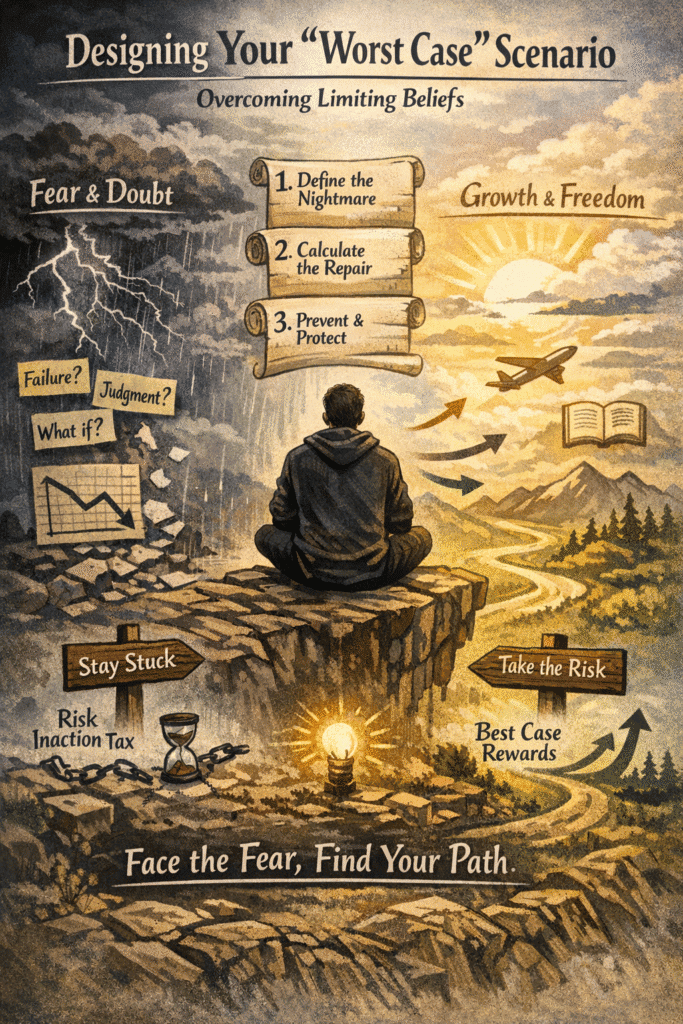
Step 1: Define the Worst Case Scenario (The “What If”)
Choose the dream you keep circling, but haven’t fully committed to – the one that carries emotional weight.
Maybe it’s writing a book, quitting your job and pursuing your dream business, or working remotely while traveling the world.
Now, write down the actual worst-case outcome if you try and it doesn’t work.
Be specific.
Not “I fail.”
But: “I try, it doesn’t gain traction, and I need to adjust my plan or timeline.”
My example:
When I started sharing my work publicly, my fear sounded like this:
I’ll put myself out there, no one will care, I won’t earn from it, and I’ll have to reassess while stuck in the unfulfilling corporate job I already have.
Key takeaway: uncomfortable – but survivable.
Step 2: Calculate the Repair (The “How Long” and “How Much”)
Now ask:
How long would it realistically take me to recover from this scenario? Months? A year? Two?
Most fears dissolve when we realize recovery is finite.
What surprised me most was this: Anyone who judged me for trying was never meant to be my long-term supporter anyway. It was a blessing in disguise.
And even in the most uncomfortable version of the outcome, I realized something grounding:
I would still have options. Stability. Skills. Choice.
The recovery period was temporary – far shorter than the years spent paying the Inaction Tax by never trying at all.
Step 3: Prevent and Protect (The “How Can I”)
This is where fear turns into agency.
Ask yourself:
What can I do now to reduce the impact of the worst case scenario?
- If the fear is financial → build a buffer (six months of runway, gradually over time).
- If the fear is credibility → seek mentorship, editing, or clear structure before launching.
- If the fear is burnout → set non-negotiable boundaries before momentum builds.
This is intentional planning – not fear-based avoidance.
You’re not hoping things work out; you’re designing resilience.
Step 4: Compare the Risk to the Inaction Tax
Finally, rate the worst case scenario on a scale of 1–10 from no impact to permanently life-changing.
Most people realize it’s a temporary 3–4.
Now rate the best-case scenario.
Growth. Fulfillment. Alignment. Freedom.
Often an 8–10.
The real danger isn’t trying and adjusting.
It’s staying where you are, hoping things improve without changing anything.
The Cost of Accepting Normalcy
We’ve all accepted that adulthood is supposed to feel heavy. You look around and everyone hates their job, just as you do. Everyone is overwhelmed with responsibilities, just as you are.
But pause for a moment and ask yourself: has being normal ever actually gotten you the things you wanted most?
Has it helped you stand out for selective opportunities – or build a life that feels expansive, fulfilling, and true to you?
Or did those moments come because you were willing to be seen, to try, and to risk being different?
Normal keeps you safe – but safety rarely leads to expansion.
The very things we want most in life often live on the other side of being seen, trying, and risking discomfort.
Let that awareness guide you forward.
The Philosophical Shift: Atman and Inner Steadiness
This exercise handles external outcomes.
But the deeper work is internal.
Your worth does not rise or fall with success or failure.
The atman – your inner steadiness – exists independent of external metrics.
The loss of a job, a friend, money, or reputation does not diminish who you are.
When you stop outsourcing your value to outcomes, judgment loses its power.
A failed attempt becomes data – information to guide your next intentional action, not a final judgment.

Living as the Main Character of Your Life
When fear is quantified and survivable, clarity returns.
Intentional living isn’t about reckless leaps – it’s about choosing alignment over avoidance. You don’t need certainty to move forward. You just need self-trust.
You’re allowed to want more, to try, to adjust without shame.
That’s the whole point of life — to learn, grow, and evolve with intention.
The bumps along the way shape us more than any “win” ever will. So create, serve, explore, connect — these are the surest routes to lasting fulfillment. The arbitrary goals never were.
✨ Your Challenge
Take five minutes today and walk through the Resilience Exercise:
- Define the fear
- Calculate recovery
- Design protection
Next week, we complete the Intentional Action Blueprint by focusing on the final piece of sustainability: Momentum > Perfection – how consistent, imperfect action fuels purpose far more than waiting ever could.
Subscribe for continued reflections and your FREE 7-day Intentional Living Workbook.
The Coaching Corner: Your Resilience Exercise
In our sessions, we look fear in the eye so it loses its power to paralyze you. We aren’t just planning for success; we are designing your resilience.
The Reflection: Look at the “Worst-Case Scenario” you defined today. Now, look past the logistics and find the Identity Fear. Ask yourself: “If the worst happened, would I actually lose my worth, or would I just lose the version of me that was performing for others?”
The Alignment Action: Identify one “safety net” you already have — a skill, a supportive friend, or your own history of overcoming a past struggle. Write it down. This is your Resilience Evidence. When the “What If” whispers get loud this week, remind yourself: “I have already survived 100% of my worst days. I am the evidence that I can handle the path.”
Ready to stop let fear drive? My coaching sessions are designed to help you move from vague anxiety to concrete confidence. If you’re tired of paying the Inaction Tax, apply here for a free session, and let’s build your anchor together.






Some great tips on resilience, thank you!