How to Build an Extraordinary Life: The Cost of Being Ordinary
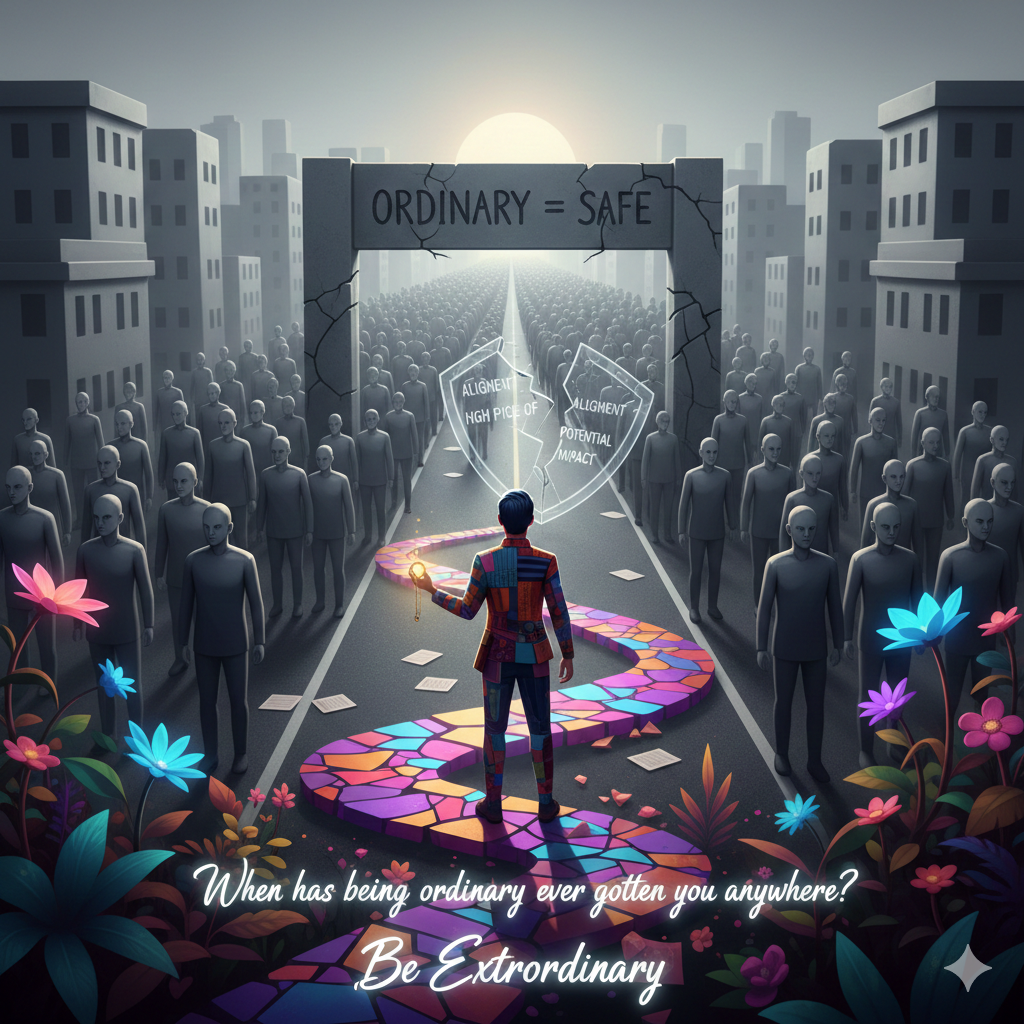
When has being ordinary ever gotten you anywhere?
We are raised to value the middle ground. We are told to blend in, to not make waves, and to follow the path that has been tread a thousand times before. In our community, “ordinary” is often framed as “safety.” It’s the stable career, the predictable routine, the socially acceptable hobbies. We are taught that being ordinary is a shield against criticism and a guarantee of a quiet life.
But there is a high price for that safety: Your alignment. Your potential. Your Impact
The truth is, “ordinary” is just another word for “compliant.” When you choose to be ordinary, you are choosing to suppress the unique edges of your personality and the specific calls of your dharma. You are trading your unique genius for a sense of belonging that, deep down, feels hollow.
The Commodity of “Normal”
Think about the things you want most in life. If you are applying for a highly selective dream job, do you think “ticking the boxes” and having the same “ordinary” resume as 5,000 other people is what gets you the offer?
No. It is the project you started out of passion, the weird niche skill you mastered, or the bold way you solve problems that makes them stop scrolling.
If you are looking for a partner who truly values you for you, do you think playing the “ordinary” role — the one who follows every cultural script — will resonate with them?
No. That only attracts someone who likes the mask. A partner who loves your soul can only find you if you are brave enough to be extraordinary.
Anything that truly fulfills you in life requires the version of you that is freely extraordinary (aka uniquely you).
The Extraordinary Life Advantage
There is a secret hidden in the unconventional path: The competition is lower.
Because most people are paralyzed by the “standardized script,” they stay within the safe, crowded lines. They wait for the annual review to ask for a raise. They apply through the same portal as 1,000 others. They accept the office schedule without question.
If you email the CEO directly with a bold idea or a request for a promotion, you might be the only person who has done so all year. You instantly gain a level of visibility that “playing it safe” could never provide. If you want a hybrid schedule and you’re the only one who presents a data-backed deck proving how it works, you aren’t just asking — you are leading.
By doing what others are too afraid to do, you actually increase your odds of success. The truth is, the “extraordinary” path isn’t just more fulfilling; it is strategically smarter.
Playing it Safe: The Cost of Being Ordinary
We think that staying within the lines protects us from failure. But the greatest failure isn’t missing a goal; it’s hitting a goal that you never actually cared about.
Let that sit for a moment.
I know this because I’ve lived it. For years, I stayed playing it safe. I built a stable career and reached a point where I’m making good money — the kind of “ticked box” that society and South Asian community celebrate. But the truth is, that was never my goal.
Today, I’d rather be pursuing my passions, even messily. I’m writing this blog and launching my coaching practice, and quite honestly, I’m in the thick of the struggle to gain visibility. It isn’t “safe” or “stable” in the traditional sense. But the everyday journey — the act of finally being true to myself — fulfills me in a way that the stable paychecks never could. And it only happened because I was willing to face my fears to be “extraordinary.”
Being extraordinary isn’t about being better than everyone else; it’s about being more yourself than anyone else.
The Fallacy of the Majority
Since we were young, we’ve been conditioned to believe that “common” equals “superior.” We see it in the way society has historically ranked people: the dominant racial group over the minority, or the “able-bodied” over the disabled. We are taught that the “norm” is the gold standard, and anything that deviates from it is a deficiency to be corrected. We are often unaware of this implicit bias because its so engraved into us.
And we’ve applied this same flawed logic to our own lives. We prefer the structured path and the standardized life not because they are inherently better, but because they are the most common.
But this forgets the most pivotal piece of our collective survival: A garden cannot thrive if every plant is a rose.
The essence of survivalhood for any society depends on a diversity of roles. We need the rebels, the healers, the late bloomers, and the non-conformists just as much as we need the administrators.
When we force everyone onto a standardized path, we aren’t just hurting the individual; we are starving society of the specific medicine that only your dharma can provide.
Extraordinary is Not a Performance
The “standardized life” I shared last week is designed for ordinary people. It is a mass-produced map for a mass-produced life. But you are a unique expression of consciousness. To try to fit your “extraordinary” potential into an “ordinary” box is like trying to fit the ocean into a tea cup.
If your dharma is calling you to build something new, to lead in a different way, or to live outside the traditional markers of success, you cannot afford to be ordinary. You cannot lead a life of impact if you are constantly checking the rearview mirror to see if the “village” approves of your speed.
Redefining the Goal: The Unconventional Path
The universe doesn’t reward those who follow the crowd; it rewards those with the courage to stand apart. Being extraordinary means:
- Honoring your “weird” interests because they are clues to your purpose.
- Setting boundaries with those who want you to stay “small” so they can feel comfortable.
- Choosing impact over safety.
Stop racing for a middle-ground that doesn’t exist. Start aligning with the extraordinary life you were designed for.
The Coaching Corner: The Extraordinary Life
The Reflection: Think about a time you tried to be “ordinary” to get something (a job, a date, a friendship). Did it work? And if it did, did you actually enjoy what you “won,” or did you feel like you had to keep performing to keep it?
The Unconventional Path: Identify one “un-ordinary” trait of yours that you usually hide to fit in. This week, lead with that trait. Whether it’s a unique perspective in a meeting or an unconventional way of spending your Saturday, notice how it feels to stop performing and start being.
Ready to stop playing it safe? I know how exhausting it is to maintain a mask of success that doesn’t fit. I help people move past the “safe” scripts and reclaim their extraordinary life. If you’re ready to stop performing for society and start building a life that feels like you — even if it’s messy at first — let’s talk. Apply here for a free coaching session!






Such an interesting article, we really have been inspired.