
The Strategic Pause: Why the Nature of a Break is Your Greatest Fuel
We’ve been sold a lie about the nature of a break.
In the script of the modern grind, and especially within the high-achieving South Asian community, we treat rest as a reward. We tell ourselves we’ll take a break once the project is done, once the house is clean, or once we’ve “earned” it through exhaustion.
It’s the invisible weight of the immigrant work ethic, the feeling that our ancestors didn’t move across the world so we could sit still.
We view rest as the finish line. But in an intentional life, a strategic pause is the fuel.
The “Always On” Script
I’ll be honest with you: I struggle with this. I get caught up in the cult of productivity, efficiency, and the hustle. My husband often tells me that I’m “always on.” My mind is constantly scanning for the next goal, the next post, the next way to be useful.
When I sit still, the inherited guilt instantly makes me uncomfortable. I start to feel like I’m falling behind or letting people down just by existing in the quiet.
But that “always on” version of me…? That’s not the real me. I don’t want it to be.
Living in work-life alignment (with your dharma) isn’t about how much you can produce; it’s about the quality of your presence. It means giving yourself permission to just be. You are enough exactly as you are, sitting still, without a single item checked off your to-do list.
Who Wrote the Rule That You Must Be “Always On”?
We live in a society that treats us like machines — expecting us to be up and running 24/7.
But who decided that our worth is measured by our output? Who says that being “always on” is the only way to be valuable?
When we buy into this “always in” script, we aren’t being productive; we are depleting ourselves.
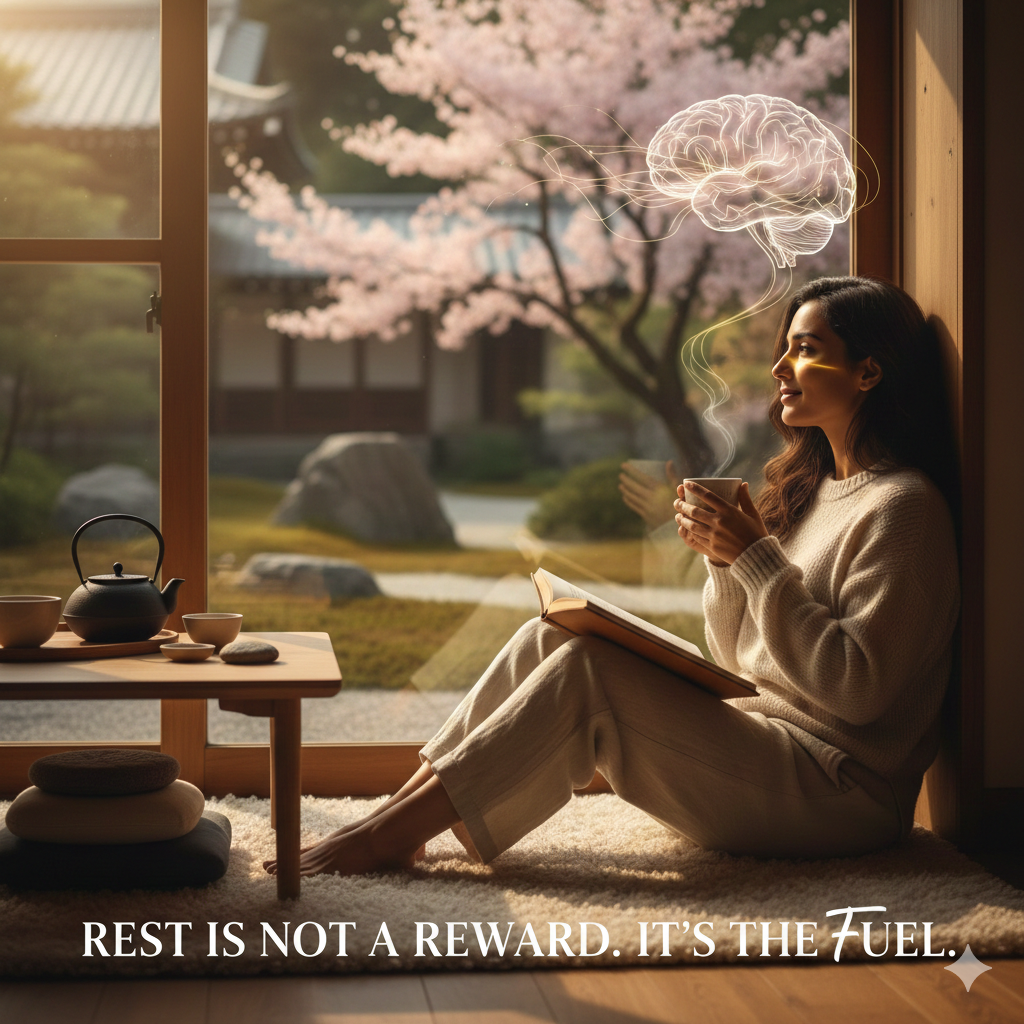
The truth is: rest isn’t a luxury; it’s a biological and spiritual requirement. If you want to be innovative, if you want to be a visionary, if you want to lead with clarity — you must rest.
Why Your Brain Needs You to Stop (The Science of Rest)
We often think we are shutting down when we rest, but the opposite is true. Science reveals the deeper reality on the nature of a break. When you stop “doing,” your brain actually begins its most important work. A strategic pause is the secret to nervous system regulation:
- The Default Mode Network (DMN): This is the “incubation” phase of your genius. It’s why your best, most innovative ideas don’t come at your desk; they come in the shower, on a walk, or during a quiet morning. When you refuse to rest, you silence the very part of your brain that solves complex problems and creates new ideas.
- Cognitive Refuelling: Research on vigilance decrement shows that the longer we stay “on,” the more our focus blurs. Think of it as a software update; you can’t run the new version of your life if you never hit “restart.”
- Emotional Resilience: Constant hustle keeps you in a state of fight or flight, flooding your body with cortisol. Integrating a strategic pause is the only way to move to let your nervous system settles, allowing you to access the empathy, intuition, or other skills that your dharma may require.
You cannot just be plugged in and expected to perform at peak capacity forever. If it’s hard for you to rest, think of rest as an essential part of your work: rest helps you recharge and perform at peak once again.
What Intentional Breaks Look Like
Inspired by Jaishree Nenwani‘s Tiny Habits Massive Results, creating space for intentional breaks or micro-rest is a non-negotiable for me this year. As a chronic hustler, it feels like a major step in supporting my dharma. It’s an act of agency to say: “My work is important, but what truly matters is my self.”
Here are some examples of intentional breaks that I build into my life:
- Daily micro-rests: 10 minutes of mindfulness meditation to tune out external noise and reconnect with the abundant atman within, or a quick walk outside during the work day.
- Social reset: Unwinding with friends and family with the purpose of pure connection.
- Simple joys: Getting lost in a book, a heartfelt movie, or a long dinner with my husband, leaving all distractions behind.
The Ultimate Boundary: The Vacation
And then, there are the bigger breaks, that are just as necessary. As you read this, I am currently on a 2-week vacation in Japan. Everything for my work is automated because I’ve chosen to honor my work-life alignment. I am not “checking in” from a temple in Kyoto or a street in Shibuya.
I am allowing myself to be a student of the world, recharging so that when I return, I can guide you from a place of fullness, not depletion.
I am trusting the systems I built to support the life I actually want to live.
(And yes, I will share stories of my travels with you all!)
The Aligned Action: Reclaim Your Right to Rest
This week, I challenge you to flip the script. Don’t wait until you’re “done” to rest.
- Dive Deeper: Ask yourself: When do you feel the pressure to be productive? Is that coming from your dharma or a limiting belief?
- Schedule a strategic pause: Put 30 minutes on your calendar this week where your only job is to exist.
- Practice Presence: The next time you have a meal or a conversation, be 100% there. Automation isn’t just for computers; it’s a mental state where you let go of the “what’s next?” to enjoy the “what actually is.”
The Reflection: If you stopped trying to “earn” your rest today, what would you have the energy to build tomorrow?
Ready to show up consistently for yourself? If you’re tired of the “all-or-nothing” cycle and want to build a life of intentional, soul-led progress, I’m here to guide you. Apply here for a free coaching session and let’s start building your momentum today.

P.S. I can’t wait to share the lessons and moments I’m capturing once I’m back. In the meantime, you can see glimpses of the beauty I’m finding in Japan on my Instagram!






The immigrant work ethic guilt is so real. It’s like you’re constantly apologizing for just sitting still.