Modern Hinduism: Hindu Cultural Traditions with Intention
Do your cultural traditions feel like a choice – or just something you grew up doing? In this post, I explore how to move from cultural obligation to intentional living by redefining Hindu traditions for the modern Hindu.
Growing Up in the South Asian Diaspora: Tradition vs. Choice
I still remember sitting cross-legged in my family’s living room, staring at the colorful puja thali in front of me, wondering why I couldn’t just skip the katha and go play with my cousins.
Growing up, I followed Hindu traditions simply because that’s what we did – passed down from one generation to the next, unquestioned.
Don’t go to the temple during your period. Wear these clothes. Say these mantras.
Like many Desi Millennials and Gen Z, while I respected these customs, I didn’t always understand the “why.” I saw Hindu tradition as a rigid set of particulars — vibrant and rich, yet far removed from my daily reality.
Deconstructing Hindu Traditions: Asking “Why”
As I got older, curiosity replaced compliance. I began to ask: What does this ritual mean? Does this tradition still serve me today?
My mom quietly modeled this approach for years. While others clung to customs out of obligation, she practiced what was feasible and let go of what didn’t work — without guilt.
Reframing the “Temple and Period” Rule
Take the traditional restriction regarding menstruation and temples. As a teen, it felt like shame; as a young adult, it felt unfair. But once I dug deeper — beyond the “do’s and don’ts” of elders — I discovered its original intent.
In a different era, this was about practical concerns and rest. It was an act of care for the body, not a form of exclusion. This reframing changed everything. I realized that the essence of Sanatana Dharma isn’t in rigid rules, but in its timeless wisdom.
4 Core Pillars of Intentional Hinduism
By looking at Hindu heritage through my own eyes, I found four specific concepts that resonate with a modern, intentional lifestyle:
- Abundance: The belief that the universe is inherently plentiful and interconnected.
- Ātman (Inner Potential): Recognizing that the power to grow and create lives within us.
- Dharma and Seva (Impact): A moral compass guiding us to act ethically and serve others.
- Connection to Roots: Returning to heritage through curiosity and free will rather than fear.
I didn’t need to take every religious story literally. I didn’t need to follow every ritual exactly. I just had to understand its core truths, from my own eyes, and choose what to carry forward with intention. And honestly, that kind of choice is empowering.
Redefining What it Means to be a “Modern Hindu”
Reconnecting with my roots meant making intentional choices. Today, my practice looks different than the one I grew up with:
I used to avoid wearing a bindi because I thought it distracted from my appearance. Now, it’s a symbol I wear proudly — an act of connection, not conformity.
When I got married, I chose a simple, modern mangalsutra I could wear every day. It felt authentic – a reminder of both my committment and my heritage.
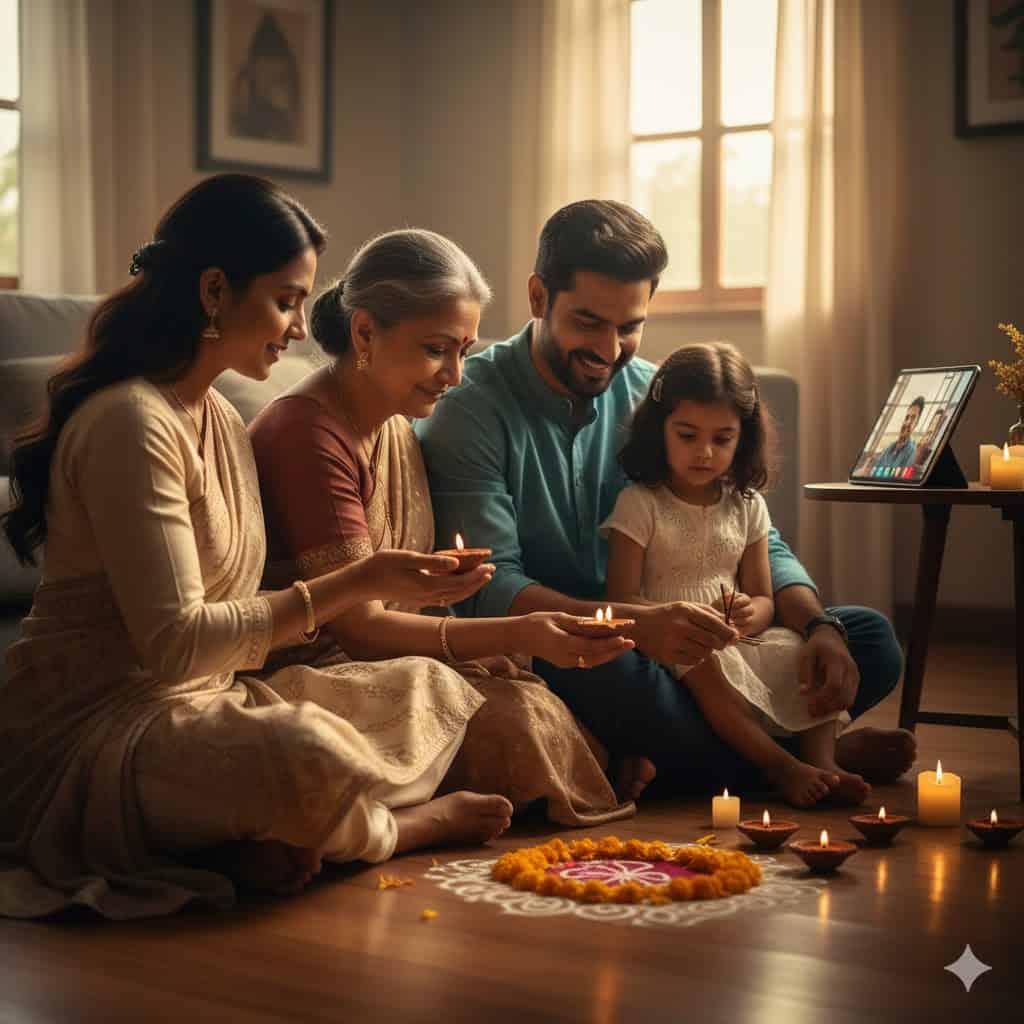
For a long time, I thought prayer had to look a certain way — standing in a temple, hands folded, reciting verses. But with time, I learned that divinity doesn’t need a specific setting. Since the ātman lives within, prayer can happen while lighting a diya at home or during a quiet moment of reflection between tasks.
Even the intention behind prayer has evolved for me.
Instead of asking for outcomes – grades, promotions, relief from a problem – I focus on cultivating inner strength, clarity, and patience to navigate life’s challenges.
This Dhanteras, when an elder told me to pray for wealth, I prayed instead for the courage to create a life rich in meaning.
Each of these choices reminds me that Hindu tradition isn’t meant to be followed rigidly. It’s meant to be lived personally, in ways that reflect who you are now.

Why Hinduism is a “Living Religion”
What makes Hinduism unique is its ability to evolve. It has always grown with us.
Even thousands of years ago, the Upanishads shifted focus from ritual to reflection, from fire offerings to self-realization.
Today, we carry that same spirit of evolution. Families celebrate Ganesh Chaturthi with eco-friendly clay idols. Communities remix Garba music with modern beats. The devotion stays the same, the expression evolves with time.
This constant evolution is what allows our spirituality to thrive within the South Asian Diaspora.
When I’m at Garba, surrounded by color and rhythm, I feel the heartbeat of my heritage. (Check it out on my Instagram) It’s pure joy. It’s belonging. It’s living tradition in motion.
It reminds me that our traditions were never meant to hold us back. They were meant to ground us, so we could grow freely.
The Essence of Hinduism: Wisdom from the Upanishads and Bhagavad Gita
Interestingly, the ancient scriptures actually support this modern, intentional approach:
- The Upanishads begin and end with one timeless instruction: Know the Self (the ātman). Everything else flows from that.
- In the Bhagavad Gita, Krishna doesn’t hand Arjuna a list of commands — he asks him to question, discern, and choose his path with awareness, not blind obedience.
- The Vedas focuses on ṛta (the natural order of the universe) and conscious living rather than punishment.
Even dharma was never meant to be one-size-fits-all — it adapts to your nature, your season of life, and your inner calling.
At its heart, Hinduism is a spiritual framework for self-realization. Just like intentional living, it doesn’t confine. It liberates.
Honestly, I think this flexibility is exactly why so many of us who were raised Hindu don’t identify as Hindu anymore. Not because Hinduism pushed us away — but because it never forced us to stay. It’s a tradition built on freedom, not fear. And when something never demands your loyalty, it’s easy to let it slip away without ever understanding its depth.
What It Means to Honor Hindu Traditions Intentionally
If you are struggling to balance your roots as a modern Hindu, try asking these three questions:
- What is the purpose or “why” behind this practice?
- What meaning does it hold for me personally?
- How can I adapt it to reflect my life today without losing its heart?
To honor your roots doesn’t mean staying still. It means growing, evolving, and carrying your heritage forward with heart.
💌 Join the Community: If this resonates, subscribe to get future posts straight to your inbox + my FREE 7-day Intentional Living Workbook.
Read more about how I’ve reclaimed ayurveda, dharma, ātman, and seva.